Samlingen
2026
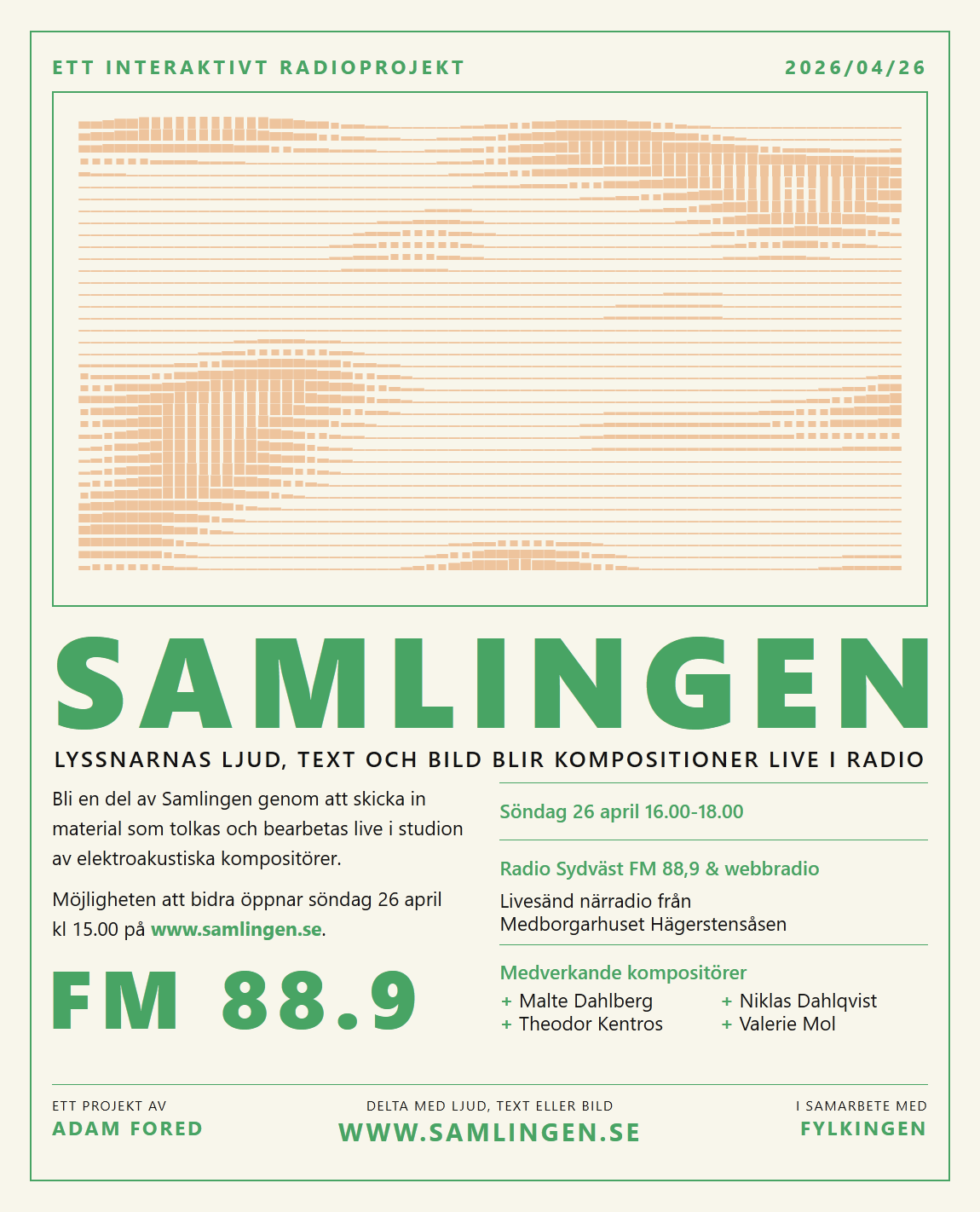
Samlingen is an interactive radio project in which submitted sounds, texts and images become material for
live electroacoustic composition. The project invites listeners to take part through a website that opens before
broadcast, where they can upload or record a sound, write a short text, or send a low-resolution image.
The submitted material is gathered in a shared pool and made available to a group of composers in the studio.
During the broadcast, the composers select, interpret and transform the material into new works, while the radio
format moves between interviews, excerpts from the submissions, and the compositions as they take shape.
Samlingen approaches radio as both a medium of transmission and a place of gathering.
The work is shaped by the contributions of its listeners, the decisions of the composers,
the conditions of the studio, and the shared time of the broadcast. Rather than presenting a fixed composition,
Samlingen creates a situation in which authorship, listening and musical material are distributed between everyone
taking part.
The first iteration of Samlingen was broadcast live on FM and web radio from Radio Sydväst at
Medborgarhuset Hägerstensåsen in Stockholm in april 2026.
Participating composers:
Malte Dahlberg
Niklas Dahlqvist
Theodor Kentros
Valerie Mol
Broadcast technician:
Jóhann Vignir
The project was created and led by Adam Fored in collaboration with
Radio Sydväst,
Hägerstensåsens Medborgarhus,
Fylkingen,
the Royal College of Music in Stockholm,
and all the participants of Samlingen.
the Collective Interaction Imprinter
2025
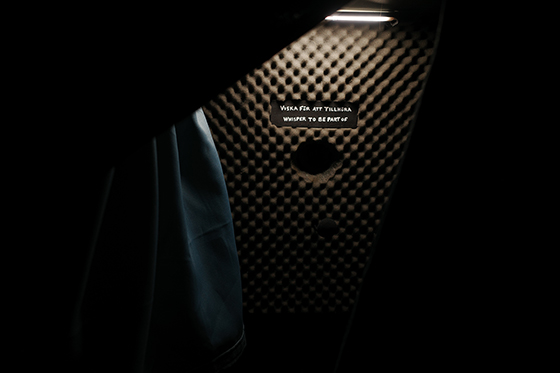
By entering this booth, you allow the machine to
film your eyes and you are given the chance to
whisper your words into a microphone. The video
and audio are separated and stored on an encrypted
server. The machine then blends your contribution
with those of other participants, creating a
living collective work within the wall.
The Collective Interaction Imprinter (CII) is a machine that
invites you to contribute a whisper and a gaze.
Your contribution is then blended with that of others to
become part of a collective work, embedded in and presented
from the building's wall.
The installation consists of a booth which you may enter. Inside, you are met by a camera, a microphone,
and a plaque that reads Viska för att tillhöra, Whisper to be part of.
The camera recognises the precense of a pair of eyes it starts up the process of gathering a contribution.
When a gaze and a whispers has been recorded the files are seperated and stored in folders on an encrypted
server. The machine then picks from its bank of contributions and assembles a collage of eyes and whispers
which it uses to creates a 16-channel audio piece together with projection mapped eyes on the buildins's
wall.
The CII was fist built for, and premiered in, the entrance hall of Västerås Konserthus in collaboration
with
Västmanlandsmusiken. The unique brick wall
which you are met by when entering the concert hall was what
first inpired the piece, a desire to embed our collective precences and traces into the very building
itself.
The machine has since the been adapted and presented in Kulturhuset Stadsteatern in Stockoholm, at the
Royal
Collage of music in Stockholm during the X-days, and in the Reactor Hall (R1) at the Royal Collage of
Technology (KTH) during Navet Week.
Diter - AdaGio
2022 - ongoing
Diter is a project by Giovanni
Onorato and Adam Fored. Their audiovisual work blends glitch aesthetics, microsounds, and
unconventional rhythms, and it is influenced by electronic, electroacoustic, and noise music.
Giovanni's work in electroacoustic and acousmatic music combines with Adam's background in visual arts and
electronics. Together they created the live-set Adagio, interlacing sound and visuals in an idiosyncratic way,
featuring self-written software and a combination of digital and analog gear that includes
Adam's self-built video synthesizer.
Diter's live-set Adagio has been performed at Valkhof Festival in Nijmegen, at Fylkingen's
90th year Festival in Stockholm, Equinox in the KTH reactor hall,
and at Norberg Festival 2026.
World Democracy Index Instrument
2025
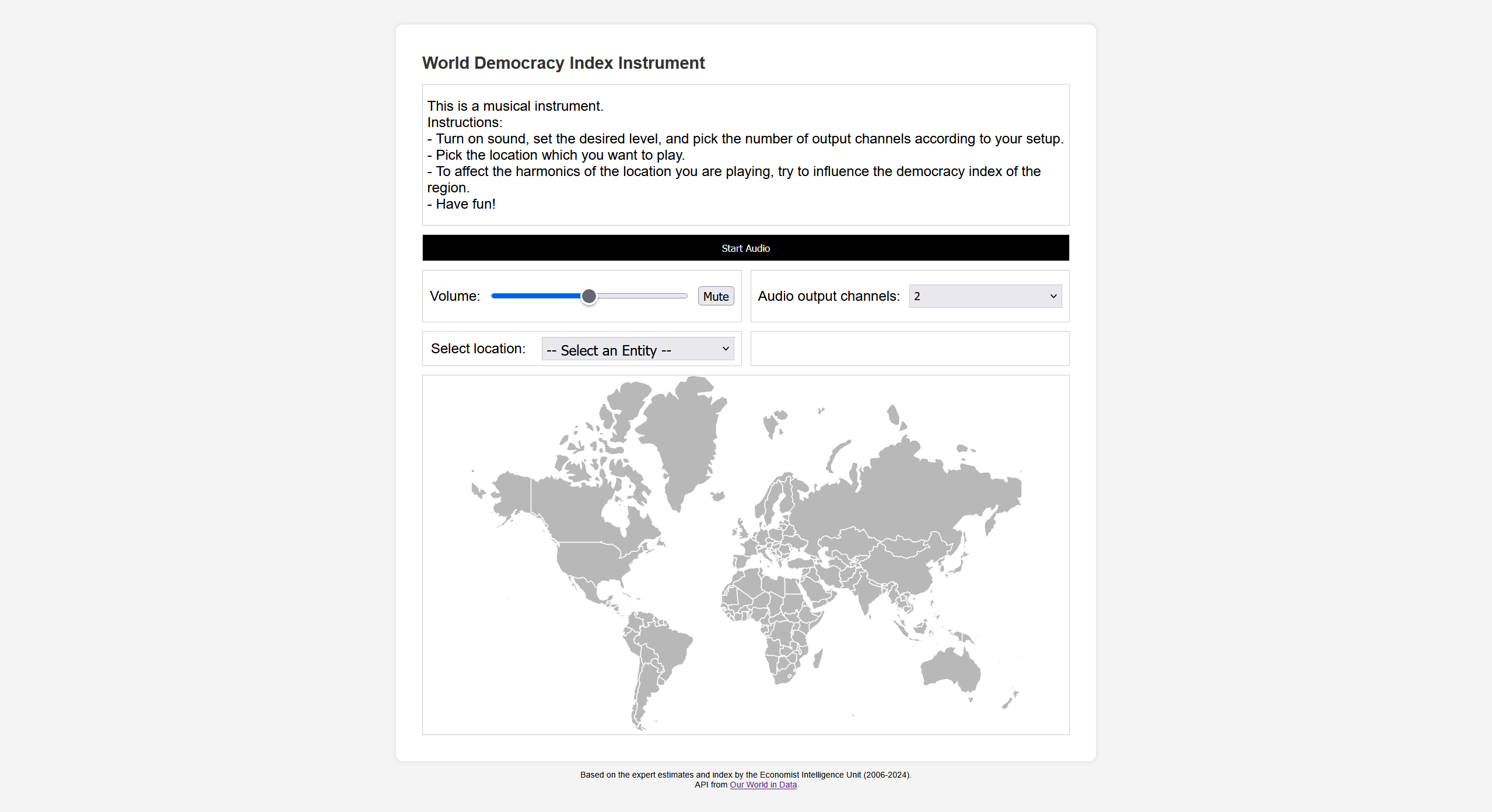
The World Democracy Index Instrument is an online musical instrument in which the user sets the
desired region which they whish to play.
The democracy index of the desired region is fetched through an API from our world in data and
sets the parameters that controls the generated sound. To influence the sound and harmonics the user needs
to influence the index of the region they are playing, through some kind of political action.
The sound-motor of the instrument is built in MAX through the RNBO-tool. You can find the patch under TOOLS.
Resolution Limits
2024
Resolution Limits is an audiovisual piece made by Adam Fored and the sound-artist and percussionist
Ryan Packard for the 360° Wisdome at the Stockholm Museum of
Technology.
The piece is based on a custom-built percussion instrument created by Packard, consisting of several
stacked drumskins with a speaker cone embedded between them. This speaker emits a range of sine tones that
excite the membranes. Packard plays the instrument by placing metal coins at the resonant nodal points of
the uppermost drumskin, subtly shifting the intricate textures produced by the setup. These textures are
highly amplified with microphones and routed to Fored's laptop, where they are live-diffused through the
dome's surround sound system.
The visuals, created by Adam Fored, are generated in TouchDesigner by manipulating particle clouds. Sound
and video are intricately linked: the particles react to the sound of Packard's instrument, while the
instrument itself is simultaneously influenced by sine tones generated through Fored's visual system. This
feedback loop between sound and image forms the core of the piece's audiovisual interplay.
Resolution Limits was performed at the Wisdome first in a standalone concert in December 2024, and
then again as part of Kulturnatt Sockholm in April 2025.
Hexadekagonal Triptyk
2024
Hexadekagonal Triptyk is a spatial audiovisual work composed for the loudspeaker dome in Lilla
Salen at the Royal College of Music in Stockholm.
The work is built around a light construction placed at the centre of the room, surrounded
by the audience and the lower ring of sixteen loudspeakers. Inside the construction, two strong light
sources are enclosed within a sixteen-sided cylindrical form. 32 solenoid-controlled shutters open and close around its
perimeter, releasing thin sectors of white light through haze above the audience.
Sound and light are generated from the same algorithmic system in Max/MSP. The composition unfolds as a
triptych: three consecutive movements that introduce, activate, and eventually destabilise the
relationship between the spatialised sound and the mechanical light structure.
Rather than using a screen as the visual surface, the work places light directly in the room. Haze becomes
a visible medium, the audience sits inside the projection field, and the audiovisual composition takes
shape as a shared spatial event.
Short documentation excerpt of the work.
Autofagi
2023
Autophagy, derived from the Greek words "auto" (self) and "phagein" (to eat), refers to the natural,
regulated mechanism that allows cells to break down and recycle their components. The process plays a
pivotal role in maintaining cellular health. Just as autophagy ensures the renewal and vitality of
individual cells, mycelium fosters the health and resilience of entire ecosystems.
The installation piece takes inspiration from symbiotic relationships between degradation and growth,
clusters, microsounds and granular processes. Three sound sculptures serve as conduits for a generative
soundscape. It invites to get closer to the earth, and the enigmatic interplay within the fungal realm.
Autofagi is an art installation created for Nobel Week Lights Stockholm 2023 as a collaborative effort
among five artists. The work consists of three sculptures, each made from wood, concrete, and acrylic
mirror, featuring built-in speakers that play a three-channel generative composition produced by a BELA
microprocessor.
Credits:
Adam Fored - Artist and Composer, Sculptor
Assar Tallinger - Artist and Composer
Nora Pollak - Artist and Composer
Vilmar Jansson - Artist and Composer
Wilma Hultén - Artist and Composer, Programmer
Hara Alonso - Project Leader
Documentation filmed and edited by Agnes Klapp.
Snapshot 2302
2023
A visual representation of real time FFT-analysis of the incoming audio.
The spectrogram is applied to the position and colour of a cloud of particles that has been arranged in
the shape of a sphere.
The music was made using the visuals as a compositional tool - so the sound and the look of the sound are
both influencing the music-making.
Made in 2023 using Max & Jitter, for the concert series "Electroacoustic Spring" held at the Royal College
of Music in Stockholm.
Primordial Soup
2023
Audiovisual piece made by Adam Fored in 2023 for concert "Unreal Graphics" at Fylkingen Münchenbryggeriet,
with audiovisual art pieces on the theme of video games.
Constructed as a game to be played in front of an audience, where the "flesh blob" chases the red dot.
This is a recording of the piece being played.
Made with Max & Jitter.
Mixdown push
2022
This is a binaural recording (2023) of Mixdown Push being played live through the 16 speakers in the
lowest ring of the speaker dome at The Royal Collage of Music in Stockholm. It was captured binaurally
with a Neumann KU 100 dummy-head microphone.
Mixdown Push is an electro-acoustic piece taking advantage of controlled phase-clicks.
The work was conceived after identifying a susceptibility in the MAX object mc.mixdown~: when its
multichannel panner is driven too rapidly, it introduces phase-discontinuity clicks.
The piece employs four sound sources:
Carrier
Sine oscillator 1 - Fundamental generator
Modulator
Sine oscillator 2 - Micro-detuned from oscillator 1 by a random, minimal interval
Support
Sine oscillator 3 - Fixed sub-bass, one octave below the fundamental
Noise
Noise generator - A noise attack is generated every time the fundamental changes
Oscillators 1 and 2 generate slow-to-fast beat patterns. At fixed time steps the instantaneous phase of
their summed waveform (-1 ... +1) is sampled and converted to pan-control data for mc.mixdown~, which
distributes the signal over a 16-loudspeaker ring. Whenever the phase readout crosses certain thresholds,
the algorithm forces the panner to a new position, provoking the phase-click.
Tillika en wacker anblick af en mindre illumination
2022
Tillika en wacker anblick af en mindre illumination is an experimental video project made together with director and filmmaker
Agnes Klapp.
The project made use of early forms of AI video-generation tools to tell the history of street lights in Stockholm.
Adam Fored created the sound design, original music, and narration for the project.
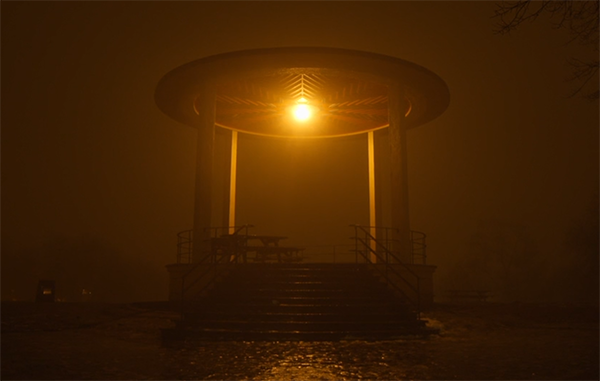
Melt
2021
Melt consists of a loop played on a very old laptop. Every time the loop cycles the amount of looping tracks is doubled as silent tracks, resulting in an increasing CPU-load. What you are hearing is the laptop struggling to play the audio and eventually crashing completely.